Chapter I: The Rise of Mahishi and the Boon of Immortality
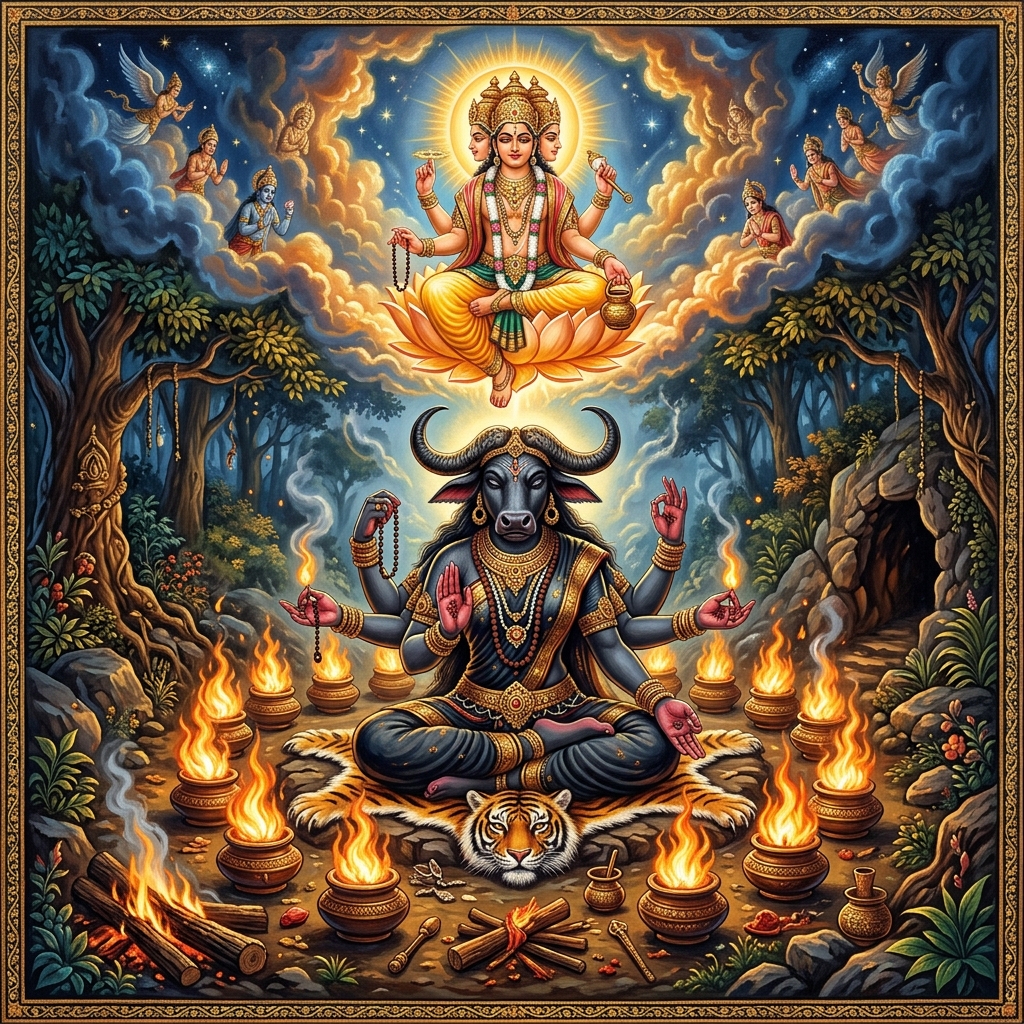
To understand the manifestation of Lord Ayyappa on earth, one must delve deep into the cosmic history recorded in the Brahmanda Purana. The story begins with the annihilation of the terrible buffalo-demon, Mahishasura, by the combined energies of the trinity in the form of Goddess Durga. While the death of Mahishasura brought relief to the three worlds, it seeded a dark desire for vengeance in the heart of his sister, Mahishi. Mahishi was a buffalo-headed demoness of immense power and iron-willed determination. Shattered by her brother's death and seeking to establish demon supremacy over the cosmos, she retired to the deep wilderness to perform intense, unprecedented penance.
For thousands of years, Mahishi stood on one leg, surrounded by five sacred fires (Panchagni), focusing her mind entirely on Lord Brahma, the creator. The sheer heat generated by her austerities began to scorch the earth and distress the heavens. Pleased by her unwavering devotion and pressured by the distress of the cosmos, Lord Brahma materialized before her. He offered her any boon she desired. Full of pride and seeking immortality, she demanded that she should never suffer death. Lord Brahma, adhering to the laws of creation, explained that every being born on earth must eventually die; absolute immortality was impossible.
Calculating carefully, Mahishi devised a condition that she believed would make her practically immortal. She knew that Lord Shiva (Hara) and Lord Vishnu (Hari) were both male deities. Therefore, she demanded: "If I must die, let my death be caused only by a son born out of the union of Lord Shiva and Lord Vishnu." She reasoned that since a union between two male gods was biologically impossible, she could never be killed. Lord Brahma granted the boon, saying "Tathastu" (so be it), and returned to his abode. Armed with this invincible shield of protection, Mahishi conquered the Devaloka, drove out Indra and the gods, and unleashed an era of absolute tyranny over sages and mortals alike.
Chapter II: The Divine Union and Birth of Manikandan
The displaced Devas (gods), led by Indra, approached Lord Vishnu and Lord Shiva, pleading for salvation from Mahishi’s relentless torment. The supreme gods understood that the time had come to fulfill the unique condition of Mahishi's boon. During the churning of the ocean (Samudra Manthan), Lord Vishnu had assumed the form of Mohini—the divine, enchanting maiden—to distribute the nectar of immortality (Amrita) to the Devas, denying it to the Asuras. Lord Shiva, hearing of Mohini's beauty, wished to see this form. Vishnu once again assumed the form of Mohini, and Shiva was deeply captivated by her divine grace and beauty.
From the holy and mysterious spiritual energy generated by the union of Lord Shiva and Mohini (Vishnu), a child of supreme beauty and radiance was born on the sacred day of Dhanu Sankranti. Because he was the son of Shiva (Hara) and Vishnu (Hari), he was named Hariharaputra. The child possessed the combined qualities of both cosmic lords—the ascetic power, courage, and meditative nature of Shiva, along with the protective grace, wisdom, and majesty of Vishnu.
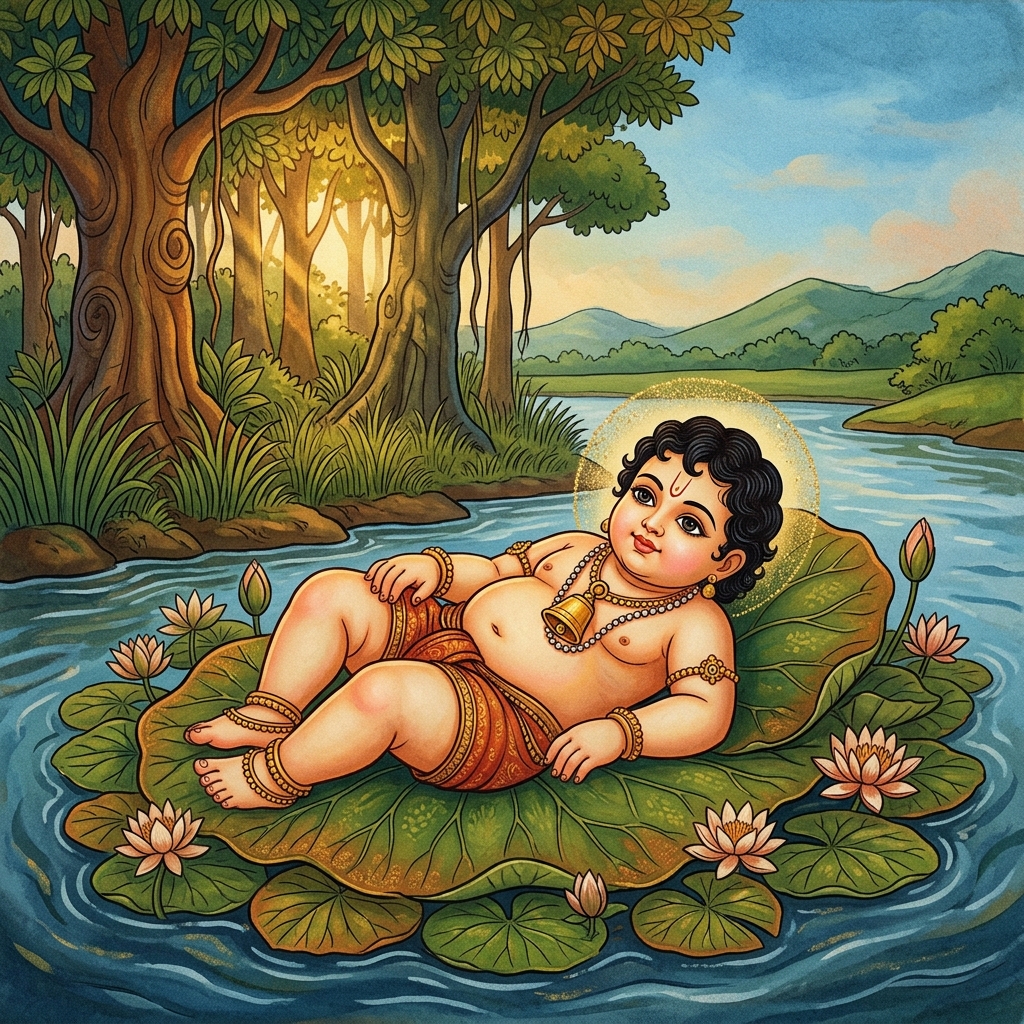
As part of the divine plan, Lord Shiva tied a beautiful golden bell (mani) around the baby’s neck, declaring that he would be known on earth as Manikandan. Shiva and Vishnu then placed the radiant infant on a soft bed of grass under the shade of a tree, on the banks of the sacred Pampa River, knowing that King Rajasekhara of Pandalam would soon arrive at the spot to fulfill the child's earthly upbringing.
Chapter III: The Royal Adoption and Life at Pandalam Palace
King Rajasekhara, the righteous ruler of the Pandalam dynasty in Kerala, was a devout king loved by all. However, he and his Queen were deeply sorrowful because they had no children to inherit the throne. The King prayed constantly to Lord Shiva for an heir. One afternoon, while hunting in the dense forests near the banks of the Pampa River, the King heard the faint, sweet cry of a baby. Surprised to hear a child's voice in the deep jungle, the King followed the sound and reached the river bank.
There, lying on a large green lotus leaf, was a beautiful baby boy, radiating a golden light, with a tiny gemstone bell fastened around his neck. As the King stood transfixed, a wandering sage (who was none other than Lord Shiva in disguise) appeared and advised him: "Do not hesitate, O King. Take this child to your palace. He is a divine child. Raise him as your own, and when he completes twelve years of age, you will witness his true divinity."
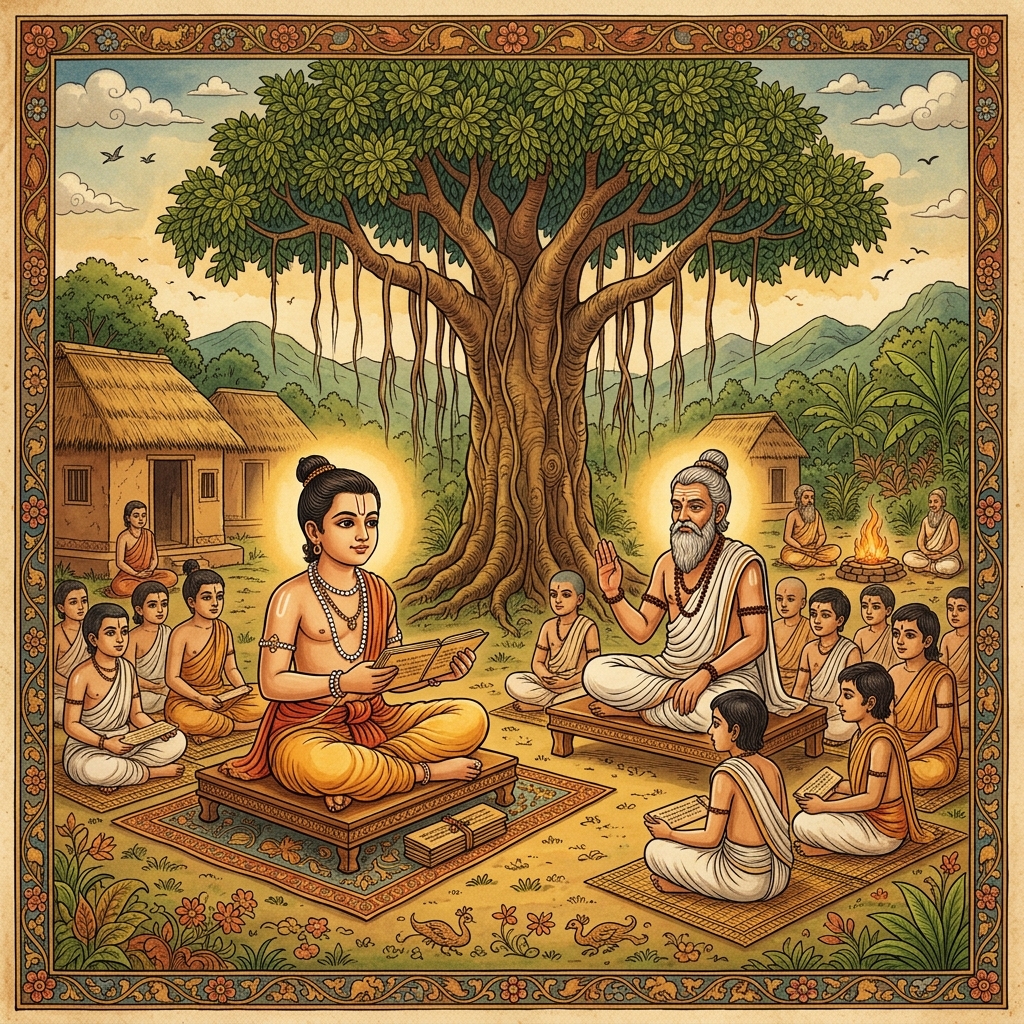
Overjoyed, King Rajasekhara carried the baby back to Pandalam and presented him to the Queen. The palace erupted in celebration, believing the baby to be a direct answer to their prayers. They named him Manikandan. Under the loving care of his parents and royal mentors, Manikandan grew up to be an exceptionally brilliant prince. He was sent to the royal Gurukul to study scriptures and martial arts (Kalaripayattu). The Guru was astonished to find that Manikandan mastered all arts, sciences, and complex philosophies in a single day, needing no repetition.
At the time of leaving the Gurukul, Manikandan wished to offer Guru Dakshina (the traditional fee). Knowing the prince's supernatural abilities, the Guru requested a miracle: his only son had been born deaf and mute, and he begged Manikandan to restore him. Manikandan gently stroked the boy's head, and instantly, the boy gained his speech and hearing. The Guru fell at Manikandan's feet, realizing that the young prince was no ordinary mortal but the Supreme Creator himself.
Chapter IV: The Palace Conspiracy and the Fake Illness
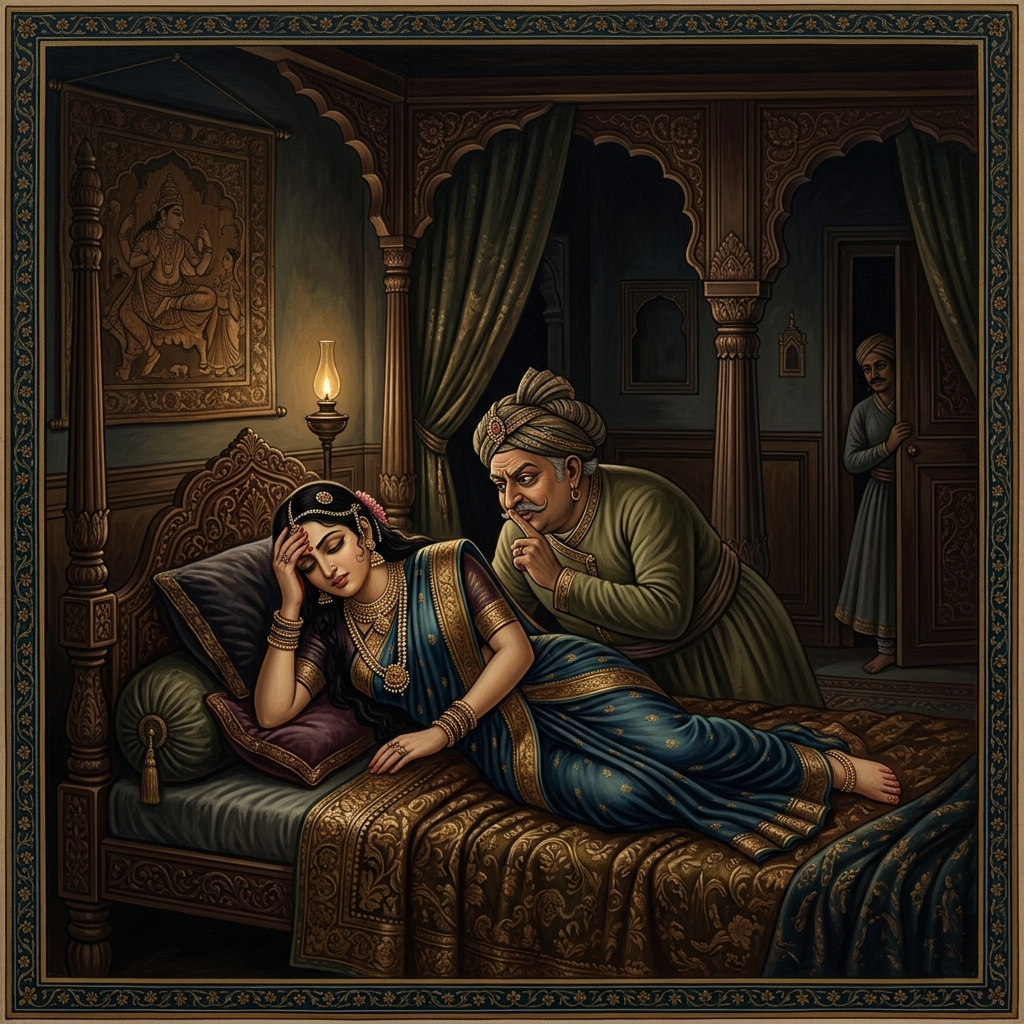
As Manikandan approached his twelfth year, the Queen gave birth to a biological son. King Rajasekhara, however, remained steadfast in his promise and love, declaring that Manikandan, the elder and most capable, would be crowned as the Yuvaraja (crown prince). The corrupt and power-hungry Prime Minister of Pandalam could not tolerate this. He wanted to manipulate the kingdom and saw the biological prince as an easy target. He approached the Queen and slowly poisoned her mind, warning her that her biological son would be treated as a servant if Manikandan became king.
The Queen, caught in the web of jealousy and manipulation, agreed to a wicked plot to eliminate Manikandan. She pretended to suffer from an unbearable, life-threatening headache. The royal physician, who was bribed by the Prime Minister, examined the Queen and declared that her illness was terminal. He claimed that the only medicine capable of curing her was the milk of a nursing tigress, which had to be fetched immediately.
King Rajasekhara was horrified, knowing that entering the tiger-infested forests of Bastar and Western Ghats and milking a tigress was a death sentence. He offered his entire wealth to anyone who would go, but no soldier or hunter dared. Manikandan, seeing his father’s distress and wanting to expose the conspirators, stepped forward. He insisted that he would go alone into the jungle to fetch the milk. Despite the King's tearful protests, Manikandan, carrying only a small bundle of coconuts and food items (which later became the prototype of the Irumudikettu), stepped into the wild forests.
Chapter V: The Slaying of Mahishi and the Celestial Dance
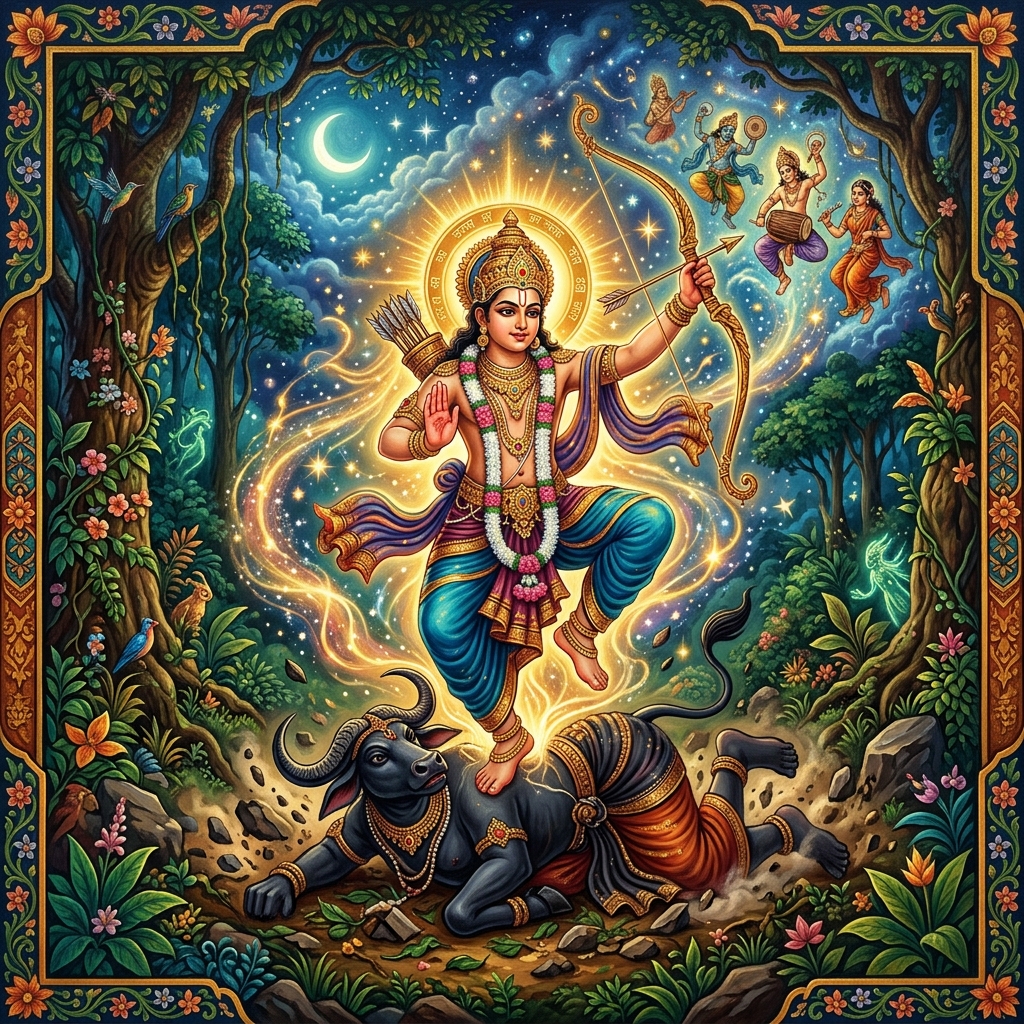
As Manikandan walked deeper into the forest, he was met by the Devas, who had been waiting for this moment. They informed him that the demoness Mahishi was currently residing near the banks of the Azhutha River, causing havoc. Manikandan redirected his path toward her. When Mahishi saw the young twelve-year-old prince entering her territory, she laughed in derision, mockingly asking if the gods had sent a child to feed her.
Manikandan drew his divine bow and let fly a powerful arrow that struck Mahishi’s chest. Enraged, the demoness took her colossal buffalo form and charged. What followed was a battle of cosmic proportions. Manikandan leaped into the air and landed on the head of the rampaging demoness. He began to dance on her shoulders and head—a divine dance of destruction known as the Tandava. The force of his steps crushed her skull and body, shattering her demonic power. Realizing that this child was the divine son of Shiva and Vishnu, Mahishi repented in her final moments.
As she died, a beautiful goddess emerged from the buffalo body. She had been Leela, a cursed daughter of a sage, condemned to live as a demoness until slain by Hariharaputra. She prayed to Lord Ayyappa to accept her as his consort. Ayyappa, intending to remain a Brahmachari (celibate deity) for this incarnation, gently declined but granted her a boon: she would reside near his temple as Malikappurathamma. He promised that if no new devotee (Kanni Swami) visited Sabarimala in any year, he would marry her—a promise that keeps thousands of devotees making their first pilgrimage every year to keep the Lord's vow intact.
Chapter VI: The Return to Pandalam Riding the Tigress
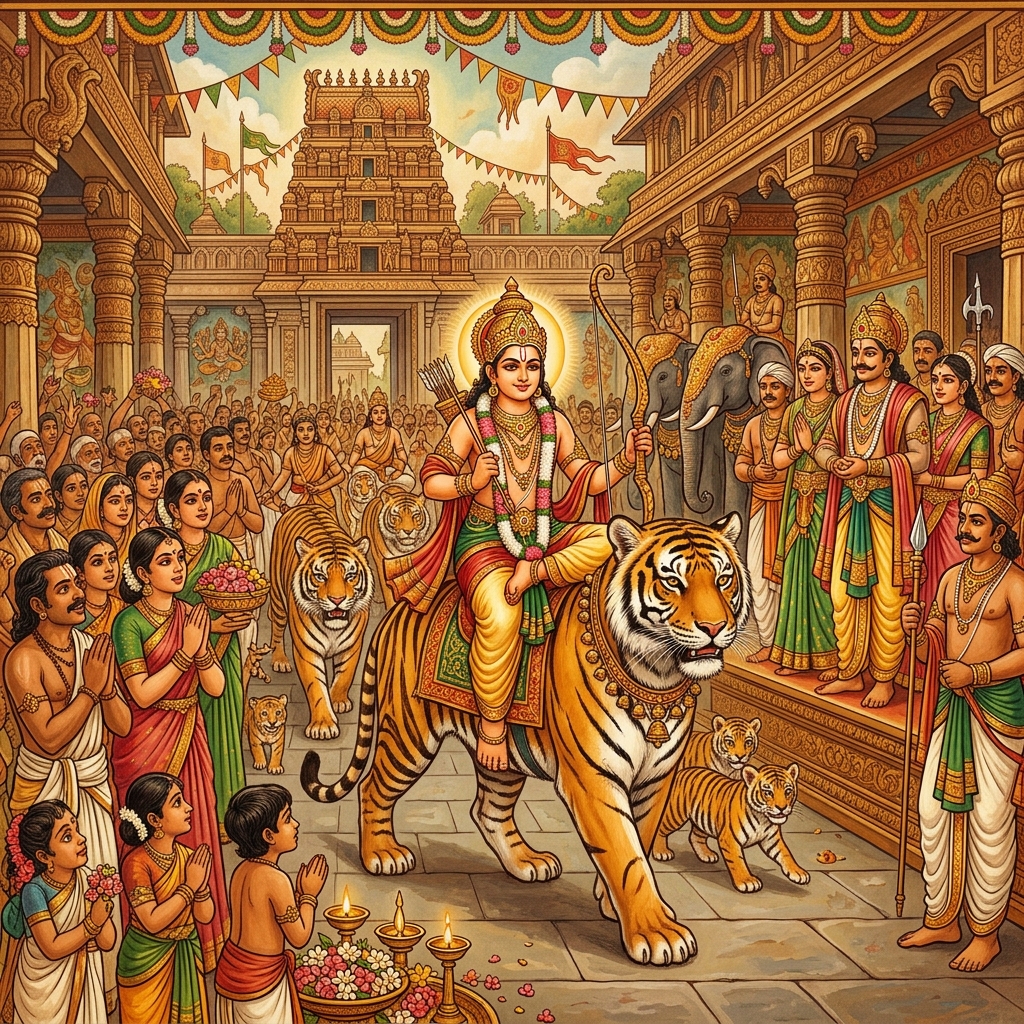
After vanquishing Mahishi, Lord Ayyappa called upon Lord Indra, who transformed himself into a magnificent Royal Bengal tigress, while the other Devas took the form of tigers and cubs. Sitting majestically on the back of the tigress, holding his bow and arrow, Manikandan began his journey back to the Pandalam palace. The sight of a twelve-year-old boy leading a pack of roaring tigers through the streets of the kingdom sent shockwaves of panic and awe through the citizens.
When the parade reached the palace gates, the Prime Minister and the Queen fainted in terror. King Rajasekhara fell at Manikandan's feet, weeping and pleading: "My Lord, I now know you are no ordinary child. Please forgive our ignorance and the sins of my family. We do not need the tigress milk. Please send these beasts away."
Manikandan smiled and released the tigers, who vanished back into the forests. He then addressed the King: "Father, my purpose on earth is fulfilled. I must now return to my divine abode. The Queen's headache was merely a catalyst to reveal my true identity. I bear no malice towards anyone." The King begged Manikandan to stay and rule the kingdom, but Ayyappa explained that his path was spiritual. He promised the King that he would always protect the Pandalam dynasty and all devotees who call upon his name from the sacred hills.
Chapter VII: Establishing Sabarimala and the 18 Sacred Steps
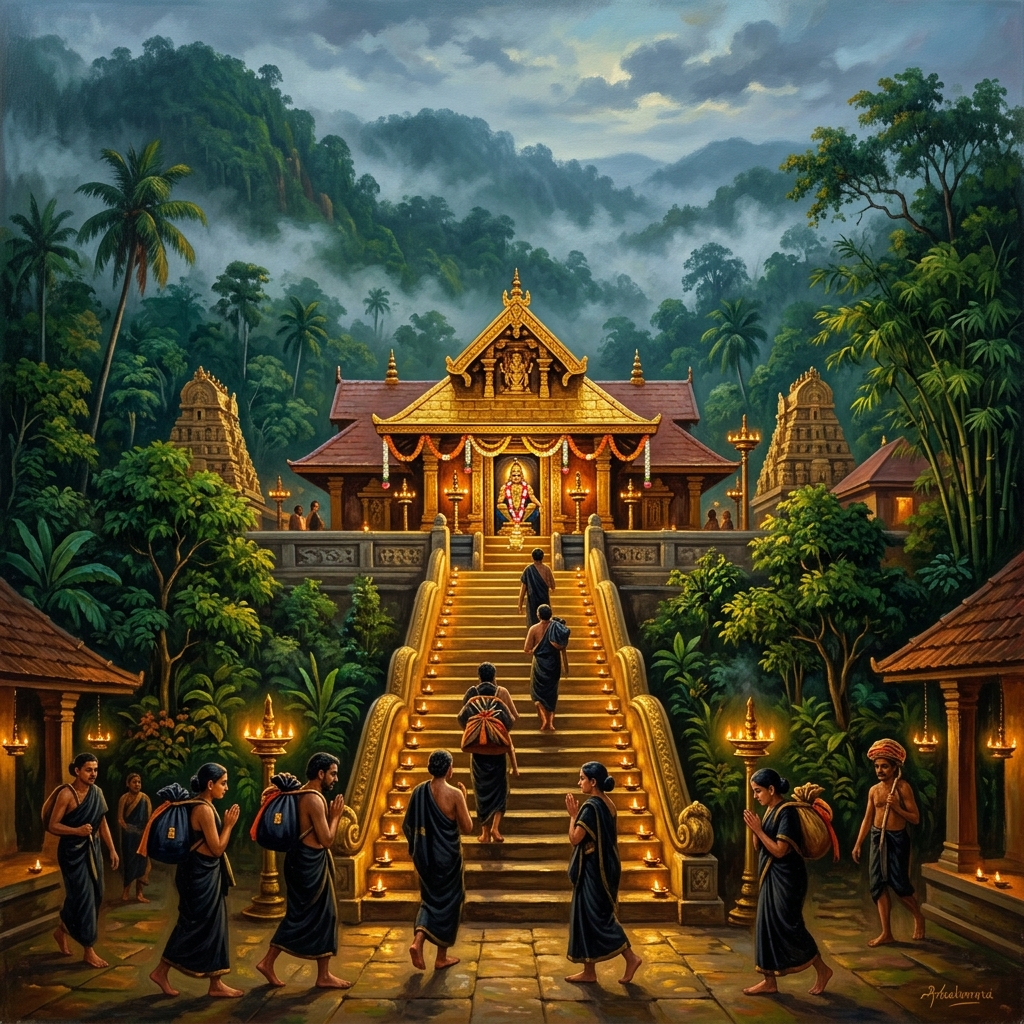
King Rajasekhara wished to build a grand temple to commemorate Manikandan's presence. He asked Ayyappa where the temple should be built. Ayyappa took his bow, placed an arrow, and shot it deep into the forest, saying: "Build my temple where this arrow lands." The arrow traveled miles and landed on the peak of Sabarimala. Ayyappa instructed the King to build the temple there, placing the 18 sacred steps (Pathinettampadi) at the entrance.
The 18 steps are not merely stone structure; they are a highly sophisticated yogic and spiritual path to self-realization. To climb the steps, a devotee must observe 41 days of strict penance (vratham), abstaining from all worldly pleasures, eating simple vegetarian food, sleeping on the floor, and practicing absolute truth and celibacy. They must carry the Irumudikettu—a two-compartment bag containing coconut filled with ghee (representing the soul) in the front, and food items (representing worldly baggage) in the back.
The spiritual symbolism of the 18 steps is deep:
- Step 1 to 5 (The Indriyas): The devotee must conquer the five senses (Sight, Hearing, Smell, Taste, and Touch) to prevent external distractions.
- Step 6 to 13 (The Ashtaragas): The devotee must overcome the eight negative emotions: Kama (Lust), Krodha (Anger), Lobha (Greed), Moha (Delusion), Mada (Pride), Matsarya (Jealousy), Dambha (Vanity), and Asuya (Envy).
- Step 14 to 16 (The Gunas): The devotee must rise above the three qualities of nature: Tamas (ignorance, laziness), Rajas (passion, activity), and Satva (goodness, purity).
- Step 17 (Vidya): The acquisition of spiritual knowledge.
- Step 18 (Avidya): Slaying of ignorance, ego, and duality.
Upon crossing the 18th step, the devotee stands before the deity, where the great Upanishadic truth is written: TAT TVAM ASI (That Thou Art). It is a reminder that the divine power you seek at Sabarimala is not outside, but resides within your own heart.
Chapter VIII: Why Lord Ayyappa Manifested on Earth & Eternal Message
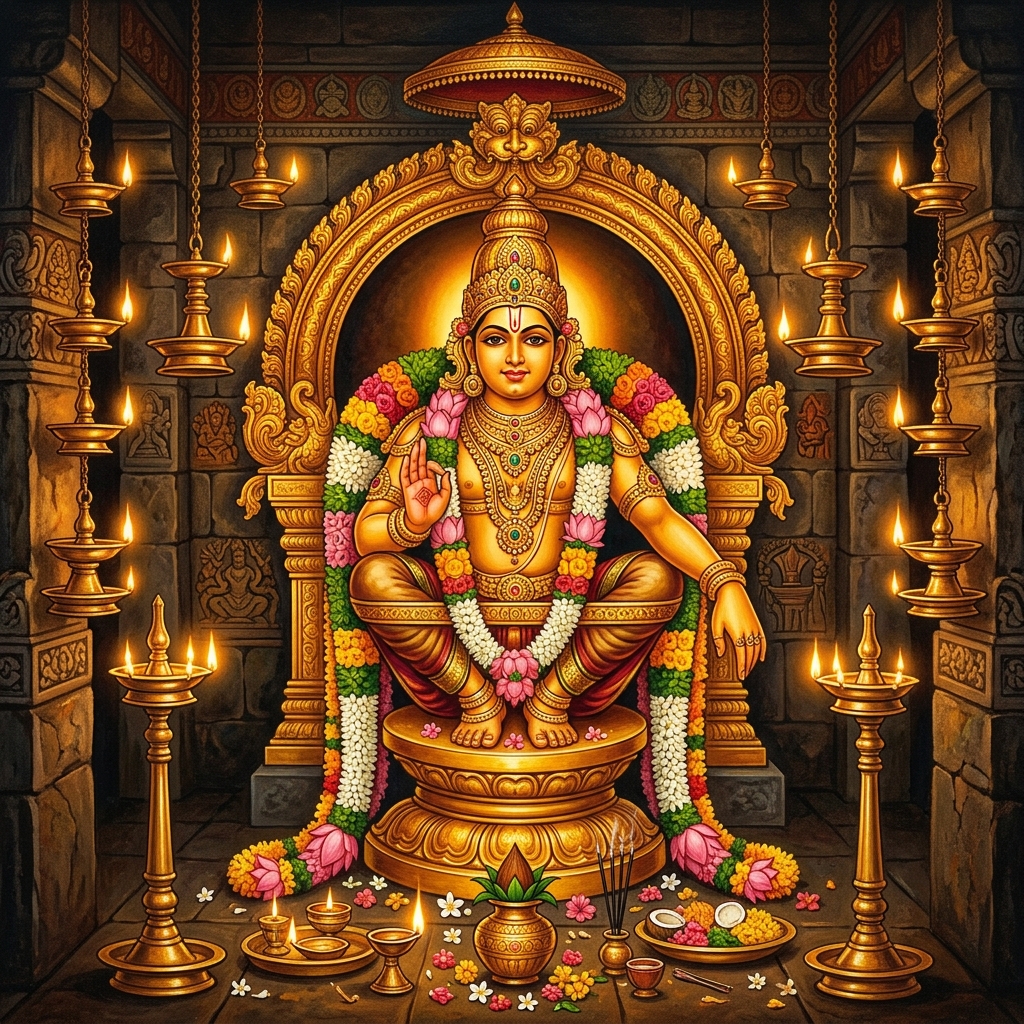
The manifestation of Lord Ayyappa represents several core spiritual lessons for humanity, especially in the age of Kali Yuga:
1. Unity of Shiva and Vishnu: Historically, there was a deep division and conflict between Shaivites (worshipers of Shiva) and Vaishnavites (worshipers of Vishnu). Lord Ayyappa, born as Hariharaputra, brings both traditions together, teaching that the absolute truth is one, though called by different names. The temple of Sabarimala accepts all sects, serving as a beacon of unity.
2. Equality and Brotherhood: In the presence of Ayyappa, all devotees are equal. During the pilgrimage, there are no rich or poor, no high or low caste. Every devotee wears black or blue clothing, carries the same Irumudikettu, and is addressed as "Swami". This breaks down the ego and fosters universal brotherhood.
3. Environmental Sanctity: The pilgrimage is an journey through dense forests, rivers, and mountains. It teaches humanity to respect and protect nature. The Pampa River, the Karimala hill, and the wildlife are treated as sacred parts of the divine playground.
4. The Triumph of Dharma: Lord Ayyappa's victory over Mahishi teaches that no matter how powerful and protected evil may seem through clever boons and manipulation, it must eventually bend before the pure, unified power of dharma. Manikandan’s simple bow and arrow, backed by absolute truth, conquered the cosmic terror.